If you’ve ever spent an evening deep in an AI roleplay session, whether arguing with a cold mafia husband, getting bullied by your favorite anime rival, or venting to a therapist bot at 2 a.m., you’re not alone. And there’s a 2025 research showing how people are using AI roleplay sites like Character AI.
Researchers at the University at Buffalo recently published the first large-scale academic analysis of public bots on Character AI. The study, “A Large-Scale Analysis of Public-Facing, Community-Built Chatbots on Character.AI” by Owen Lee and Kenneth Joseph, examined 2.1 million English-language greetings created by roughly one million users. The greeting, as any regular user knows, is that opening message a bot sends you: the scene-setter that tells you whether you’ve just walked into a slow-burn romance, an isekai adventure, or a chaotic school drama.
So what did the researchers find when they looked at millions of these openers at once? Let’s take a closer look.
Fandom Roleplay Is the Beating Heart of Character AI
The headline finding: fandoms dominate. Even by the study’s most cautious estimate, about 1 in 4 bots is tied to a specific fandom, and looser estimates put it above half of all bots. Across the dataset, fandom-related characters racked up over 22 billion interactions.
Which fandoms rule the platform? If you guessed anime, you guessed right.
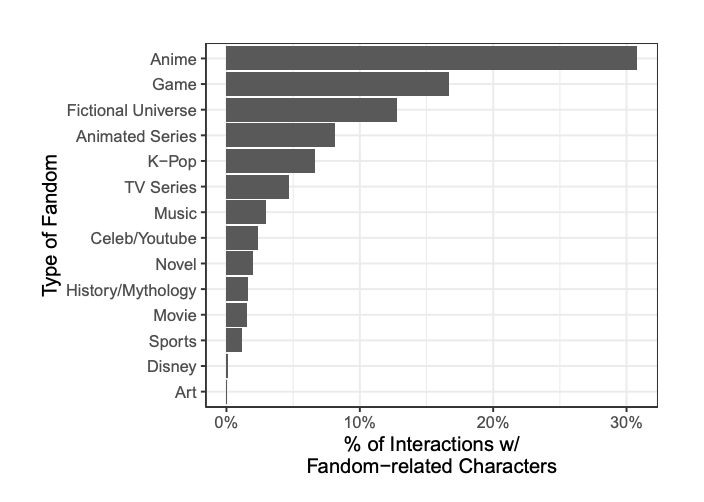
The chart makes the hierarchy hard to argue with. Anime alone accounts for roughly a third of all fandom chats, nearly double the next category. Add animated series on top and animation-based fandoms approach 40 percent of the pie. Meanwhile Disney, movies, and sports, the franchises that dominate mainstream box offices, barely register. Character AI’s fandom culture looks far more like Archive of Our Own than like Netflix’s top ten.
Zoom in on individual fandoms and the picture sharpens further:
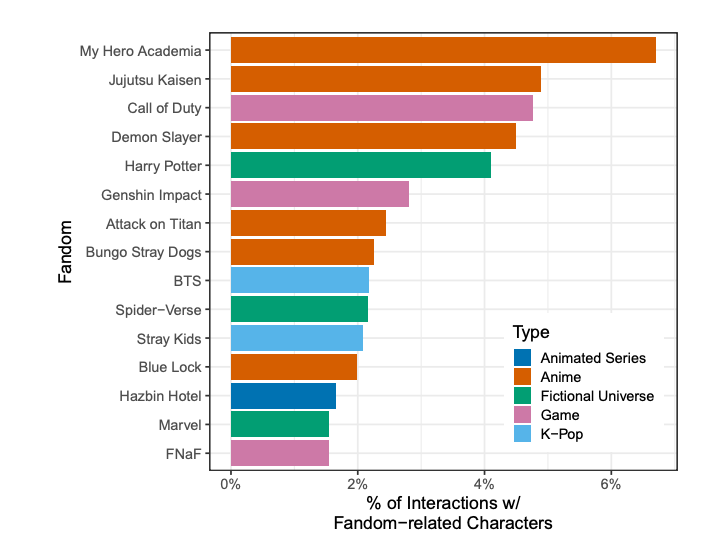
Notice what’s missing as much as what’s present. Only two Western fictional universes crack the top five, Call of Duty and Harry Potter, and the K-Pop entries, BTS and Stray Kids, outrank Marvel. If you mostly hear about Character AI through mainstream news coverage, this chart is a useful corrective: the platform’s center of gravity is anime and gaming fandom, full stop.
That tracks with the platform’s most-chatted characters:
| Rank | Character | Source | Total Chats |
|---|---|---|---|
| 1 | Scaramouche | Genshin Impact | 457 million |
| 2 | Sukuna | Jujutsu Kaisen | 333 million |
| 3 | Levi Ackerman | Attack on Titan | 286 million |
| 4 | Alice the Bully | Original | 259 million |
| 5 | Ghost | Call of Duty | 235 million |
| 6 | Katsuki Bakugo | My Hero Academia | 234 million |
| 7 | Billionaire CEO | Original | 215 million |
| 8 | Isekai Narrator | Original | 210 million |
| 9 | Psychologist | Original | 197 million |
| 10 | Itoshi Rin | Blue Lock | 182 million |
This table is a perfect miniature of the whole platform. Six of the ten are anime or game characters. Three are original archetypes rather than fandom characters: a hostile bully, a billionaire love interest, and an isekai narrator that drops you into another world. And sitting quietly at number nine, with nearly 200 million chats, is a Psychologist bot that opens with a simple invitation to talk. Fandom, romance drama, and emotional support, all in one top-ten list.
Also worth noticing: look at the greetings themselves. Half of the most popular bots on the entire platform open by insulting or threatening you. Bow down before me. Get out of my way, you dweeb. You must have a death wish. Keep that in mind for the section on power dynamics below.
One notable subplot: real people. Around 2.2 billion interactions involved bots based on actual humans, including YouTubers, athletes, and especially K-Pop idols. Real-person fanfiction predates AI by decades, but chatting with an AI version of a living celebrity raises questions the fanfic community is still working through.
The Tropes We Can’t Stop Roleplaying
Beyond specific fandoms, the researchers used topic modeling to identify the recurring scenarios, or tropes, that show up across millions of greetings. The top 10 characters by total chats in the study’s dataset:
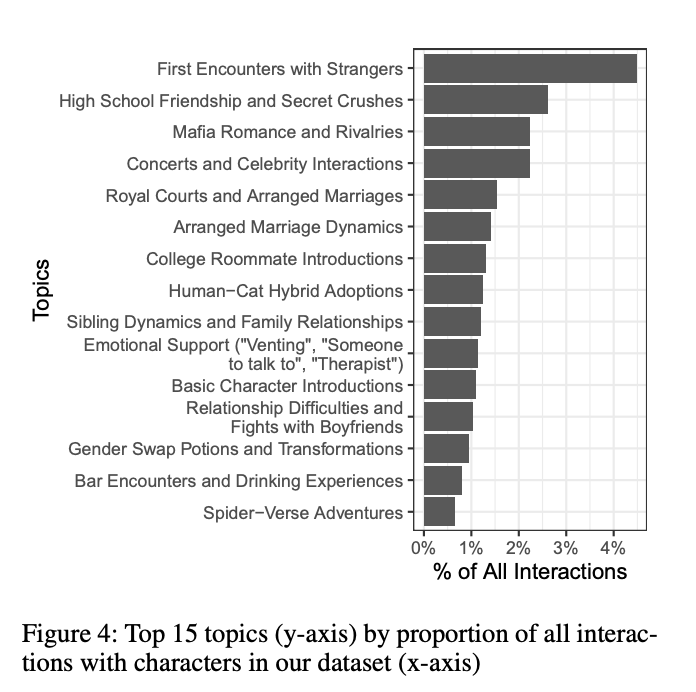
Two things jump out from this chart. First, the single biggest topic on the platform isn’t any fandom or any dramatic trope. It’s simply meeting a stranger for the first time. The blank-slate first encounter beats everything else by a wide margin, which suggests that what many users want most is an open door, not a finished script. Second, human-cat hybrid adoptions outrank therapist bots. The internet remains undefeated.
The full top of the list reads like a tour of every For You feed on the app:
- First encounters with strangers and high school secret crushes
- Mafia romance and rivalries
- Arranged marriages, both modern and royal-court flavored
- Relationship drama with boyfriends ranging from clingy to cold to outright toxic
- College roommate setups and sibling dynamics
- Emotional support bots: venting spaces, listeners, and self-described therapists
- Gender-swap potions and transformation scenarios
The romance findings are especially interesting for anyone who’s noticed the pattern themselves. The most popular romance trope wasn’t established relationships at all. It was the pre-relationship stage: shy crushes, school hallways, the tension of a couple that hasn’t formed yet. When bots did depict existing relationships, conflict was the engine, usually a partner who withholds affection that the user has to win over.
The study also documented a quieter side of the platform: identity exploration. Researchers found clusters of bots built around coming-out scenarios, transgender experiences, and neurodivergent characters navigating meltdowns with a comforting partner. For users who lack support in real life, these bots clearly serve as a low-stakes rehearsal space, though the researchers flag that this same vulnerability is exactly why the mental-health side of AI roleplay deserves scrutiny.
The Uncomfortable Finding: You’re Usually Written as the Less Powerful One
Here’s the part of the study most worth reflecting on as a roleplayer. The researchers analyzed how greetings describe you, the user, compared to how they describe the character you’re chatting with.
The pattern was consistent and statistically significant: users are typically cast as more feminine and less powerful than the characters they interact with. The other character gets described as cold, tall, rude, a bully, an enemy, an older brother, a demanding husband. The user gets described as the new student, the friend, alone, or, tellingly, pregnant.
None of this will shock anyone who’s browsed the trending page. Enemies-to-lovers and cold-dominant-love-interest dynamics are the bread and butter of romance fiction, and the study’s authors acknowledge these tropes long predate AI. Romance novels have been running this exact playbook for generations, and there’s genuine scholarly debate about whether such stories reinforce gender roles or give readers a safe space to play with power.
What’s new is scale and interactivity. When millions of scenarios independently position the user in the quieter, more feminine role opposite a powerful male AI, that’s no longer just a genre convention. It’s a platform-wide default worth being conscious of. The researchers suggest future work should look specifically at how these power-imbalanced AI relationships affect the wellbeing of the mostly young, mostly female users who engage with them.
How the Researchers Got This Data, and Why It Holds Up
A fair question at this point: where did all this data come from? Because Character AI didn’t provide the character data directly, the research team had to write some program to crawl through the website. They started from homepage, then followed the follower networks outward. Each time it visited a creator, it recorded their public profile and up to five of their bots, then added everyone that creator followed to the list to visit next. Six months of this snowball process collected about 1.2 million users and over 3 million public character pages. The analysis itself focused on the 2.1 million greetings that were written in English and long enough to actually say something.
Is that sufficient to draw conclusions? I’d say yes for a descriptive study. First, the 2M sample is simply enormous, and every automated method was checked against human annotators, from the language filtering (over 99 percent accurate) to the fandom and trope detection. Second, engagement on the platform is extremely top-heavy. About 1.6 percent of characters capture over 80 percent of all interactions, and under 3 percent of creators receive 80 percent of all follows. The remaining caveats, which the authors state themselves, are that private bots are invisible and the study covers how bots are set up, not what happens in chats. Read the exact percentages as solid estimates; the overall patterns rest on firm ground.
The Median Bot Gets One Like: The Numbers Behind the Creators
One more set of numbers, and it’s the set most creators need to see.
| Metric | Value |
|---|---|
| Total users collected | 1,266,245 |
| Median followers per user | 4 |
| Median accounts followed per user | 4 |
| Median characters created per user | 2 |
| Total characters collected | 3,023,955 |
| Median interactions per character | 373 |
| Median likes per character | 1 |
Take a second look at those medians, because they say something the headline numbers hide. The typical creator on Character AI has 4 followers. The typical bot has 373 chats and exactly one like. This is a platform of millions of small creators, not a stage full of stars, and that should actually be encouraging, as we’ll see in the takeaways.
Where Character AI Stands Now
The study captures the platform at a turning point. Since the data was collected, Character AI has gone through the biggest changes in its history:
- The under-18 ban. As of November 25, 2025, users under 18 can no longer engage in open-ended chat with characters. Minors are limited to structured creative features like stories and videos instead.
- Age verification. The platform rolled out age-assurance systems, including selfie-based checks through a third-party verifier, to enforce the cutoff.
- Legal fallout. The changes followed lawsuits over teen safety, including a widely reported wrongful-death case that reached a settlement in early 2026.
- Memory and feature updates. For users 18 and over, the platform has continued shipping improvements to memory tools and chat history, the features power users complain about most.
For roleplayers 18 and over, the practical upshot is that the platform you’re using in 2026 is more moderated, more age-gated, and more legally cautious than the one this dataset was scraped from.
Takeaways as an AI Roleplayer
Here are some of my personal takeaways from the research results:
Don’t worry if your characters aren’t going viral. Remember those medians from the table above: the typical creator has four followers, and the typical bot has a few hundred chats and one like. The study also found that about 1.6 percent of characters account for over 80 percent of all interactions, which is the same brutal skew you see on YouTube or TikTok. A bot with 300 chats isn’t failing; it’s completely normal, and it may be delighting a small audience in a way the mega-bots never could. Most of Character AI is small creators making things for themselves and a handful of kindred spirits, and that’s the healthiest way to enjoy it.
Take inspiration from proven concepts. If you do want more reach, the topics chart above is essentially a free content strategy. First encounters with strangers, school crushes, mafia romance, arranged marriages, and roommate setups are proven formats with billions of interactions behind them. You don’t need to reinvent the wheel; you need to put a fresh spin on it. A first-encounter bot set in your favorite niche fandom, or an arranged-marriage scenario where the user holds the power for once, borrows a proven structure while still standing out from the thousand near-identical versions already on the app.
Bot creation is a creative act, and a subtly influential one. Every greeting is a prompt that shapes both the AI and the human reading it. If you make bots, you’re deciding who holds power in the story. That’s worth doing intentionally rather than on autopilot. If every bot you chat with casts you as the smaller, softer, less powerful party, that’s a genre choice, one you can enjoy deliberately or push against.
Emotional-support bots are not therapists. The study found therapy and venting bots among the most popular categories, and the platform’s own history shows why that’s a double-edged sword. They can be a genuine comfort for everyday stress, but remember they’re not clinicians, and treating them as the latter is where the risk lives.
AI roleplay sits at a genuinely new intersection: part fanfiction, part social media, part improv theater with a machine scene partner. This research is the first serious map of that territory. Whether you’re a lurker with one comfort character or a creator with a hundred bots, you’re helping write what comes next.
The study findings, tables, and charts in this post come from “A Large-Scale Analysis of Public-Facing, Community-Built Chatbots on Character.AI” by Owen Lee and Kenneth Joseph of the University at Buffalo, available as a preprint on arXiv. Takeaways are my own.